88% use AI as a tool. Almost nobody built a system.
Here’s a test I like. What did AI do for your business while you were asleep last night?
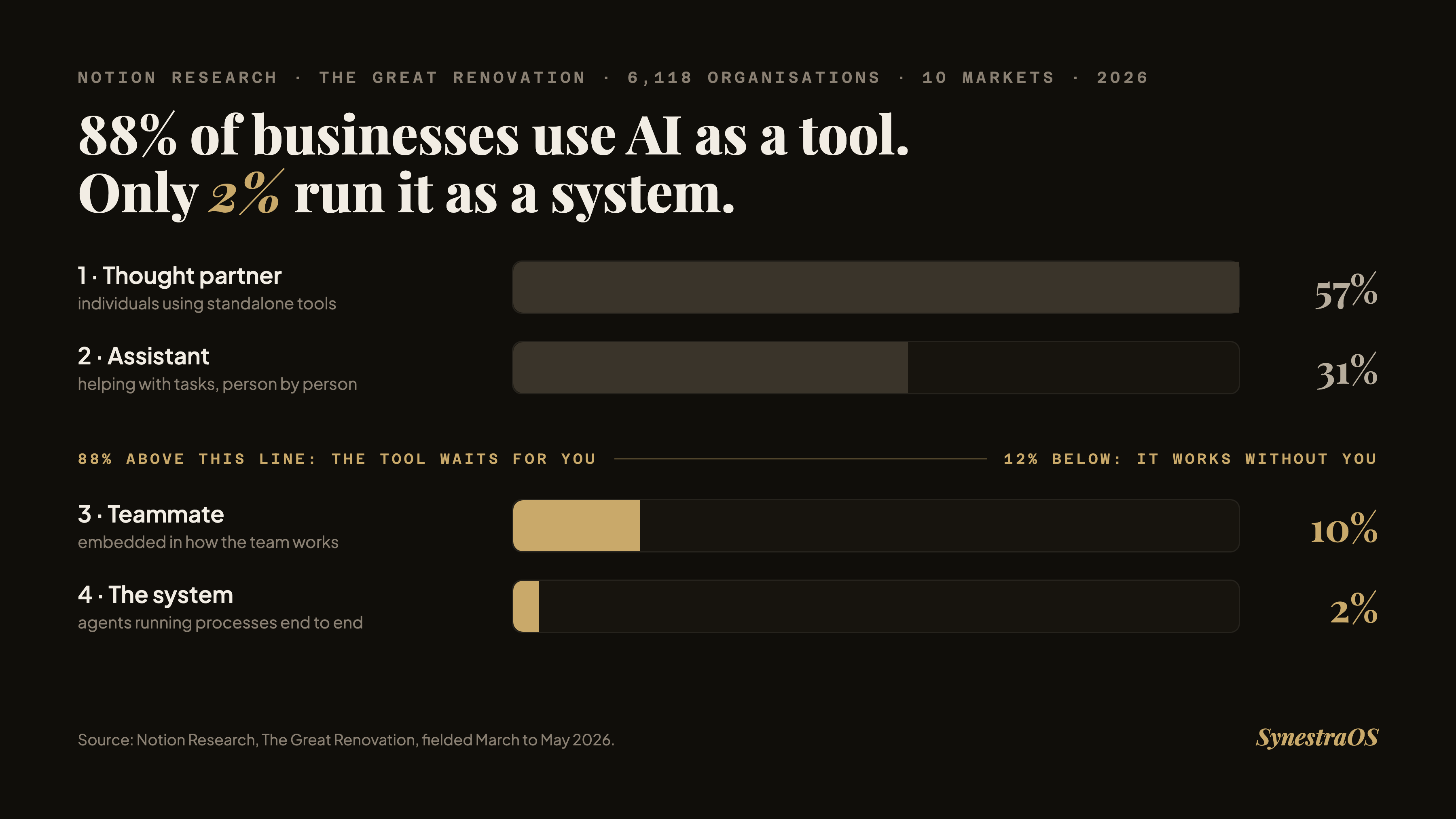
If the answer is nothing, you’re in good company. Notion’s research team asked 6,118 organisations across ten markets, Australia included, how they actually use AI. 88 per cent are still at the shallow end: a chat window open in a tab, a person typing questions into it. Useful, genuinely. But it all stops the moment you close the laptop.
Only 12 per cent have AI working as part of the business itself. And just 2 per cent run it as a system, where the work happens end to end without a human driving every step.
That gap is the most interesting number in small business right now. Not because the 88 per cent are doing anything wrong, but because the door to the other side is wide open and almost nobody is walking through it.
What did the study actually find?
The report is called The Great Renovation, fielded between March and May 2026. It sorts AI use into four levels:
- AI as a thought partner (57 per cent): individuals using standalone tools.
- AI as an assistant (31 per cent): AI helping with tasks, still person by person.
- AI as a teammate (10 per cent): AI embedded in how the team works.
- AI as the system (2 per cent): autonomous agents running real business processes end to end.
Fair warning: Notion sells AI software, so the framing serves them. But the shape of the finding matches what I see on the ground every week. Most businesses I talk to have subscriptions. Very few have structure.
What’s the difference between an AI tool and an AI system?
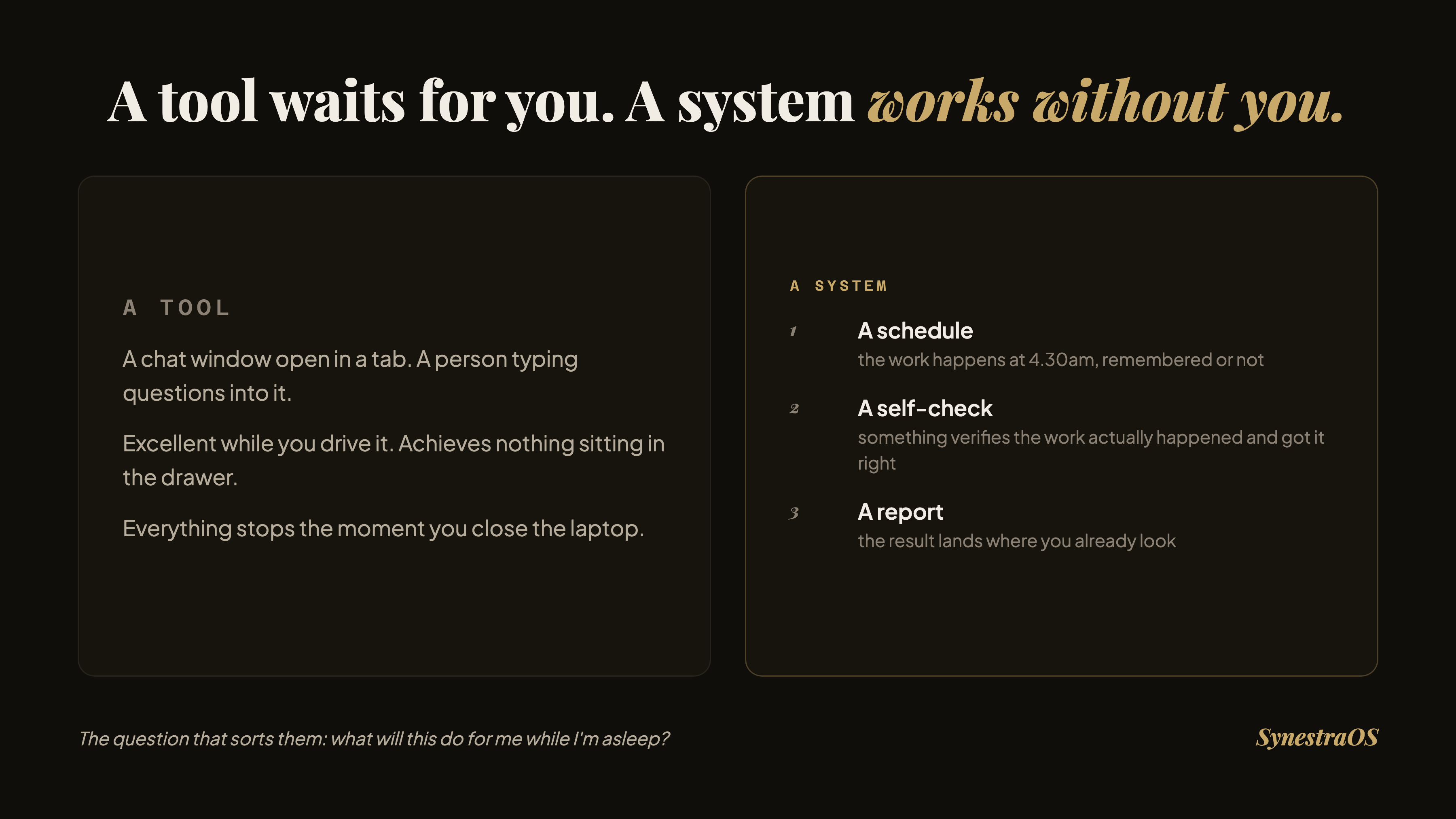
A tool waits for you. A system works without you.
That’s the whole distinction. Most of us use AI the way we use a stapler: pick it up, use it, put it down. The stapler is excellent. The stapler also achieves nothing sitting in the drawer.
A system has three things a tool never has:
- A schedule. The work happens at 4.30am, remembered or not.
- A self-check. Something verifies the work actually happened and got it right.
- A report. The result lands where you already look, so you read outcomes instead of chasing tasks.
Schedule, check, report. If those three words describe any part of your AI setup, you’re in the 12 per cent. If not, you own some very good staplers.
What does an AI system actually look like in a real small business?
Not theory. Here’s my own Friday.
At 4.30 this morning, a briefing was written and delivered to my phone: what’s live, what’s stalled and what needs a decision across the businesses I run. I was asleep. Nobody typed a prompt.
Every Monday at 4.45am, a research agent reads the week’s AI news from sources I chose, filters it against the tools my businesses actually use, and sends me a short digest with a verdict on each item: adopt, trial, or watch. That one loop replaced the one to two hours I used to spend scrolling X hoping to trip over something useful.
All of it reports to a single dashboard. One dark screen, every business on it, service health, the week’s priorities, the latest intelligence. It rebuilds itself every 30 minutes, and if it ever fails to rebuild, it flags itself as stale so it can’t quietly lie to me.
And on Monday mornings, a separate loop audits the other loops. Did the reports land? Did anything silently die? It only speaks up when something is wrong. Silence means healthy.
I’m a photographer by trade. I’ve run my own businesses for nearly three decades, and I built all of this in the evenings with an AI assistant doing the engineering while I made the decisions an owner should make. No developers. No enterprise budget. It runs on a small home server and a Mac.
Don’t you need to be technical to build one?
You need to be technical the way you need to be a mechanic to drive: not much, if you have the right passenger.
The honest requirement isn’t code. It’s the owner’s discipline to answer three questions about one task:
- What should happen, exactly, and when?
- How would I know it worked?
- Where do I want the answer to land?
Answer those and an AI assistant can build the loop with you. Refuse to answer them and no amount of software will save you, because a system is just your own standards, written down and given a schedule.
Where would you start?
Not with a platform. With one loop.
Pick one thing you repeat every week that follows the same shape each time. Pulling the week’s numbers. Scanning industry news. Chasing the quotes that went quiet. Then give it the three parts: a schedule, a self-check, and a report that lands where you already look.
One loop, running reliably, beats ten tools you have to remember to open. And the second loop is easier than the first, because now there’s a pattern to copy.
That’s the entire road from the 88 per cent to the 12. Not a transformation programme. One loop, then another.
The question worth asking
The 88 per cent aren’t behind because the technology is out of reach. It’s the same AI everyone has. The difference is structure, and structure is a decision, not a purchase.
So the next time someone shows you a shiny new AI tool, ask the only question that sorts the staplers from the systems: what will this do for me while I’m asleep?
If you’d like one worked example of this each week, from someone actually running it, that’s what this blog is for.
And if you already know the task you’d hand over first, the one that only happens because you push it, tell me about it in the seven questions. I’ll reply with the first loop I’d build in your business.